Yard Drainage
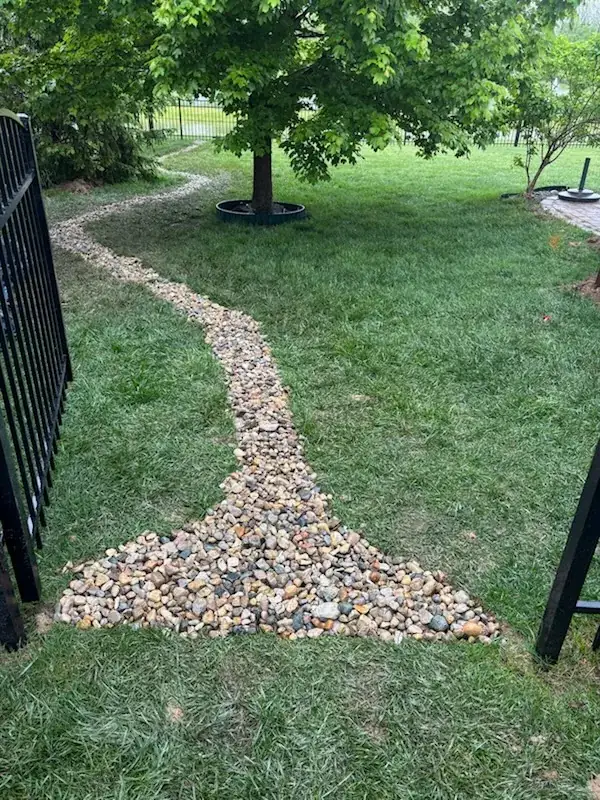
Standing water and soft ruts, piped out to daylight.
See what is inside →- Reading where water actually travels
- Catch basins, solid pipe and pop-up emitters
- Why fall matters more than pipe size
Trenching, French drains, sump pumps and crawlspace work across central and southern Indiana. No skid steer tracks across your lawn. The sod goes back where we found it.
Start here
Pick the one that sounds most like your house. We will tell you what usually causes it and where to read more.
Almost every wet basement we see in Indiana starts outside, not inside. Roof water lands within a few feet of the wall, the ground around the house has settled flat or back toward it, and the block wall takes the hydrostatic pressure. We follow the water from the roofline down before we ever talk about the inside of the wall.
Central Indiana sits on heavy clay. Water that lands on it has nowhere to go down, so it sits until it evaporates. The fix is giving it somewhere to go sideways: a graded swale, a buried perforated line, or both, pitched to daylight.
One inch of rain on a 1,500 square foot roof is roughly 900 gallons. If your downspouts release it at the corner of the house, that is 900 gallons soaking the soil right against your foundation. Burying the discharge and carrying it out to daylight is usually the cheapest fix on the whole property.
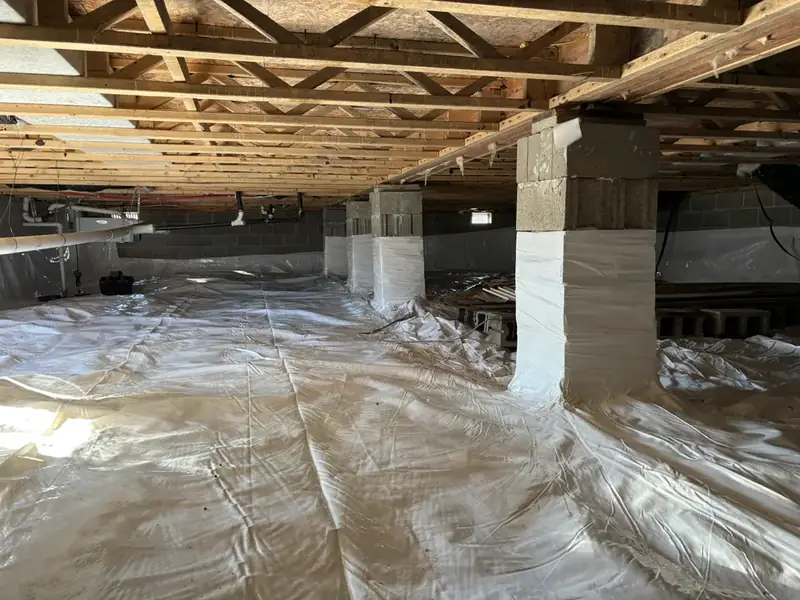
A damp crawlspace smell is soil moisture evaporating into the space and then rising into the house. Sealing the ground with a heavy vapor barrier, correcting outside grade and drying the space stops the cycle. We crawl the whole space first so you know what is actually down there.
A pump running nonstop is usually a pump doing a job the yard should be doing, or a pump that is undersized, or one discharging so close to the house that it recycles the same water. We look at all three before selling you a bigger pump.
Soil settles. Ten or twenty years after a house is built, the backfill around it has dropped and the fall has gone flat or negative. Rebuilding a proper swale so the ground carries water away from the wall is quiet, unglamorous work that fixes a surprising number of basements.
What we do
Grouped by where the water is giving you trouble. Every one of them is dug by hand.
Standing water and soft ruts, piped out to daylight.
See what is inside →The same system, dug with shovels instead of a machine.
See what is inside →For the lawn that never dries out. We diagnose before we quote.
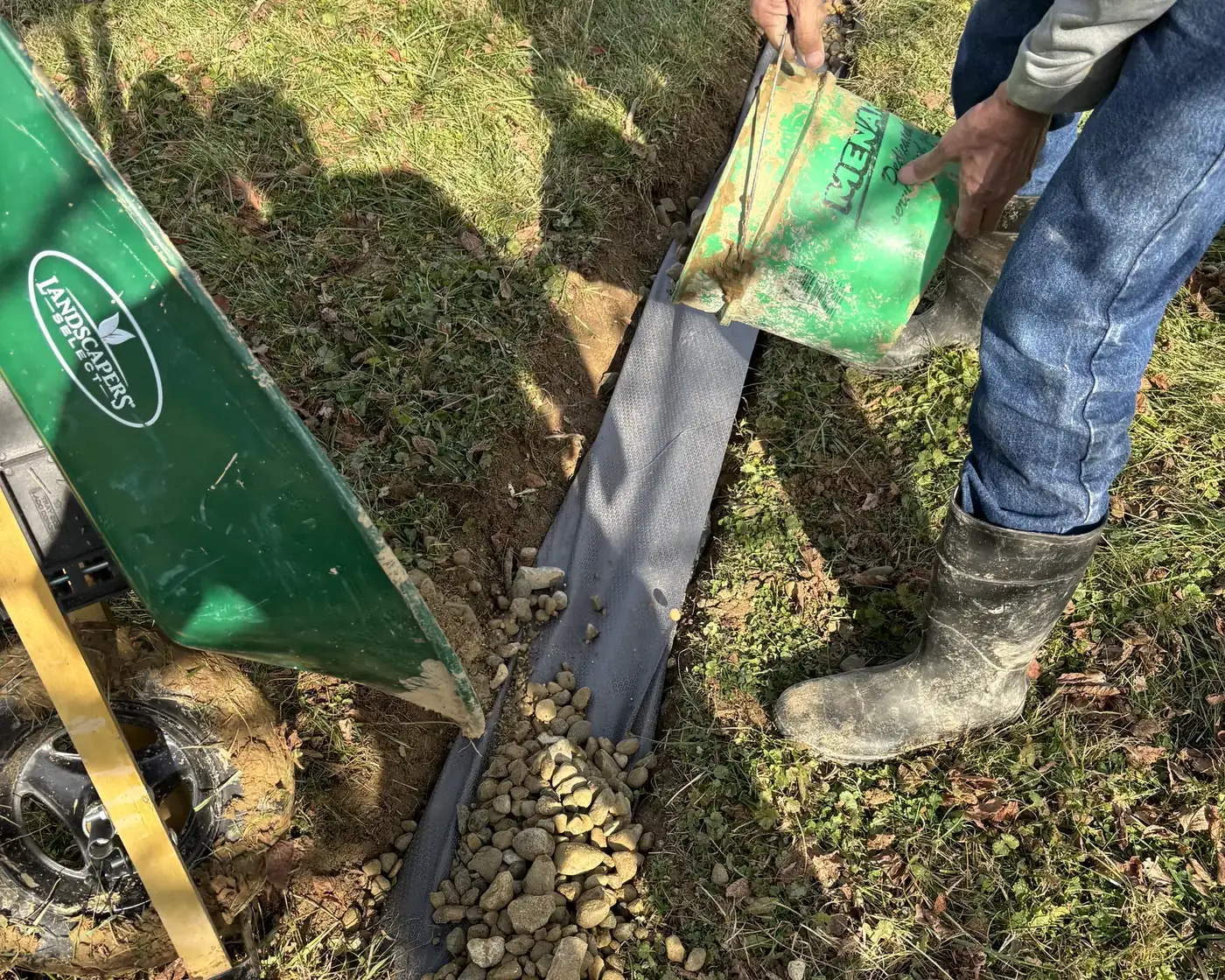
See what is inside →Perforated pipe and washed stone, built to still work in year fifteen.
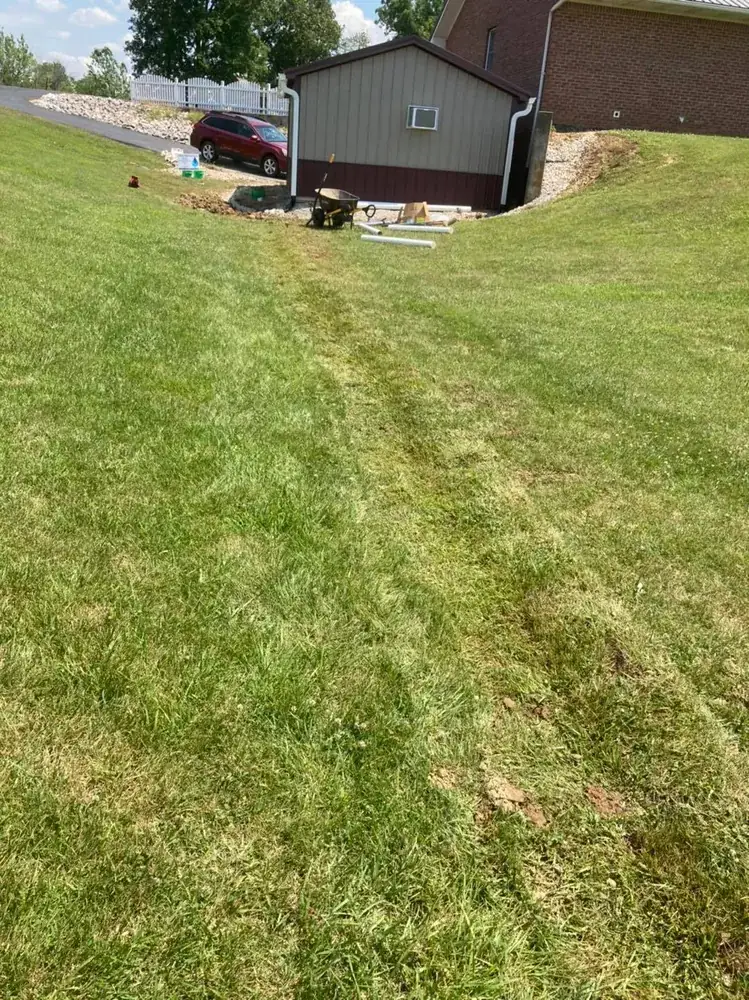
See what is inside →Roof water buried and carried out past the foundation.
See what is inside →The cheapest fix on the property, and often the one that works.
See what is inside →Rebuilding the grade so the first ten feet fall away from the wall.
See what is inside →A grated channel that catches sheet flow off a drive or patio.
See what is inside →We chase the water from the roofline down, not from the wall in.
See what is inside →Heavy vapor barrier, drainage and drying, done properly.
See what is inside →Pit, pump, backup and a discharge line that gets water away.
See what is inside →The finish work, while we are already setting grade and stone.
See what is inside →What sets us apart
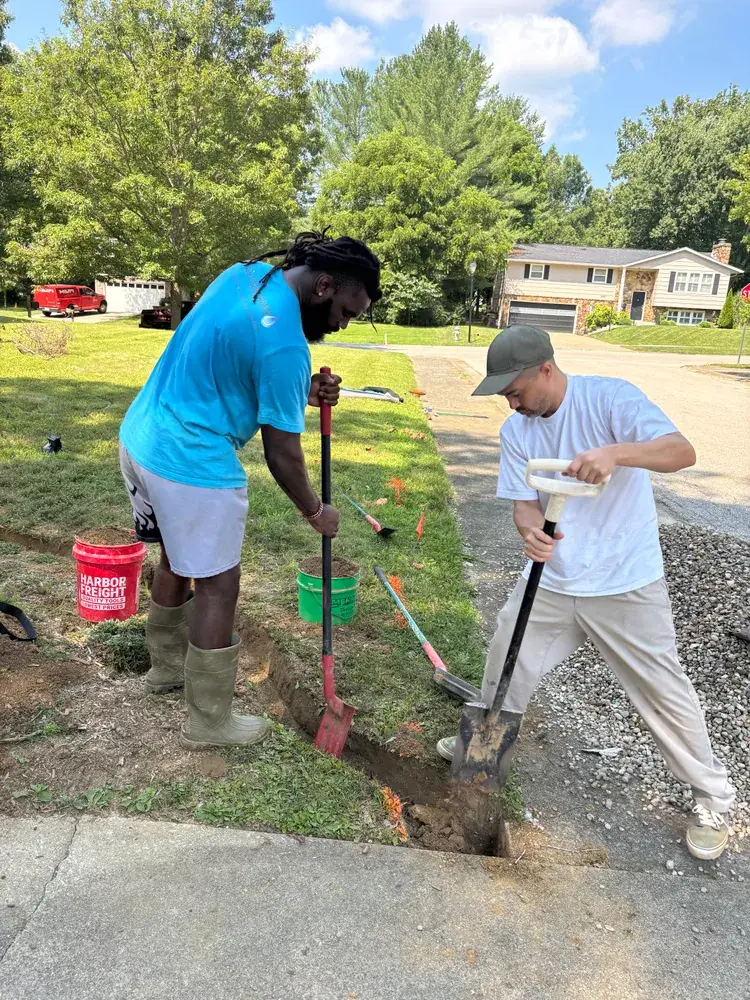
Most drainage contractors show up with a mini excavator or a trencher. It is quicker for them, and it leaves you with rutted turf, compacted soil, torn irrigation and a landscaping bill on top of the drainage bill.
We use what we call the zipper method. Three sides of the sod get cut and the fourth is left attached, so the turf hinges open, waits beside the trench, and folds back into the exact spot it came from. Then we dig the line, set the pipe and stone, and close it up. On most jobs you can see where we were for a few weeks, and then you cannot.
From your neighbors
These update themselves. Nothing on this page is typed in by us.
Where we work
We run three bases: Kokomo, Indianapolis and Bloomington. That covers most of the middle of the state, from Howard County down through Marion and into Monroe.
Also serving: Westfield, Noblesville, Avon, Brownsburg, Greenwood, Bargersville, Geist, McCordsville, Fortville, Greentown, Russiaville and Ellettsville.
How a job goes
Tell us what you are seeing and when it started. We answer leads within about 30 minutes during business hours.
We watch where water actually goes, check the fall with a level, and mark the line. No charge, and no pressure to sign anything that day.
A fixed price for a defined scope. Half down holds your spot on the schedule, and the balance is due when the work is finished.
Sod, mulch and stone get reset over the line. The soil we dug out gets raked and spread around the property where it is useful, so you are not paying for a dump trailer.
"We do not run heavy equipment through your yard. Wherever we dig, the grass goes back where it was."
Anthony Piatt, owner. It is the first thing he says on almost every estimate.
Sent by a past customer?
Past customers and their referrals get 10% off. Mention who sent you when you call.
Who shows up
Hoosier Water Away started in February 2016. Anthony Piatt runs it, his daughter Mareana runs the office, and the same small crew has been putting pipe in the ground across Indiana ever since.
We are not a franchise and we do not subcontract the work out. If you get a quote from us, the person who wrote it is the person who will be in your yard.
Recent work


Questions we get every week
Yes, for the trenching and the drainage lines. That is the whole point of the company. We use shovels, mattocks and wheelbarrows instead of a mini excavator or a walk-behind trencher, because those machines tear up turf, compact the soil either side of the trench and often break irrigation and low-voltage lines nobody knew were there.
Where a machine is genuinely required, for example a very long run through open ground with no lawn to protect, we will tell you that on the estimate rather than pretend otherwise.
Our average job runs around $4,000, but the range is wide. A single buried downspout run is a few hundred dollars. A full perimeter system with a new sump, a long discharge line and rock beds on a large lot can be several times the average.
Price is driven by trench length, depth, how much stone the job needs, how hard the ground is and how much finish work goes back on top. You get a fixed written number after the on-site visit, not a range over the phone.
Yes. The on-site visit and the written quote cost you nothing, and there is no obligation. We would rather walk the yard with you and turn down a job we cannot do well than sell you a system that will not solve the problem.
Half the quoted price is due to schedule the work and cover materials, and the balance is due when the job is finished and you have walked it with us. We do not offer financing.
Past customers, and anyone a past customer sends our way, get 10% off. Just tell us who sent you.
Days, not months. The zipper method leaves the turf hinged along one uncut edge, so it folds back into the same cut it came out of and knits in over a few weeks of normal watering and mowing. Compare that with a machine-dug job, where the tracks and the dumped soil usually mean reseeding or new sod across a much wider area.
It stays on your property. We rake and spread it wherever it is useful, filling a low spot, evening out a soft area, or building up a bed. Nothing gets loaded into a trailer and hauled away, which is part of why hand digging comes in at a sensible price.
If you would rather it went somewhere specific, tell us on the estimate visit and we will put it there.
No. We are a scheduled-work company, not an emergency service. If you have active water coming into a finished basement right now, call a water-mitigation company first to get it dried out, then call us to fix the reason it got in.
We answer new messages within about 30 minutes during business hours, Monday through Friday 9am to 7pm and Saturday 9am to 5pm.
Usually not for a residential drainage line that stays on your own property. It changes when the discharge crosses into a public right-of-way, ties into a municipal storm system, or runs inside a regulated drain easement. Hamilton County, for example, requires a permit from the County Surveyor before you work within a regulated drain easement.
We flag anything like that during the estimate so it is handled before we dig, not after.
We work out of Kokomo, Indianapolis and Bloomington, which puts most of central and south-central Indiana inside our normal range. If you are outside the towns listed on our service area page, call anyway. Depending on the size of the job we may still be able to get to you.
Free estimate
Send the form and we will get back to you within about 30 minutes during business hours. Or call and talk to a person right now.