
Crawlspace encapsulation across Indiana
Nobody looks under their own house. We do, and what we find down there usually explains a problem you have been smelling upstairs.
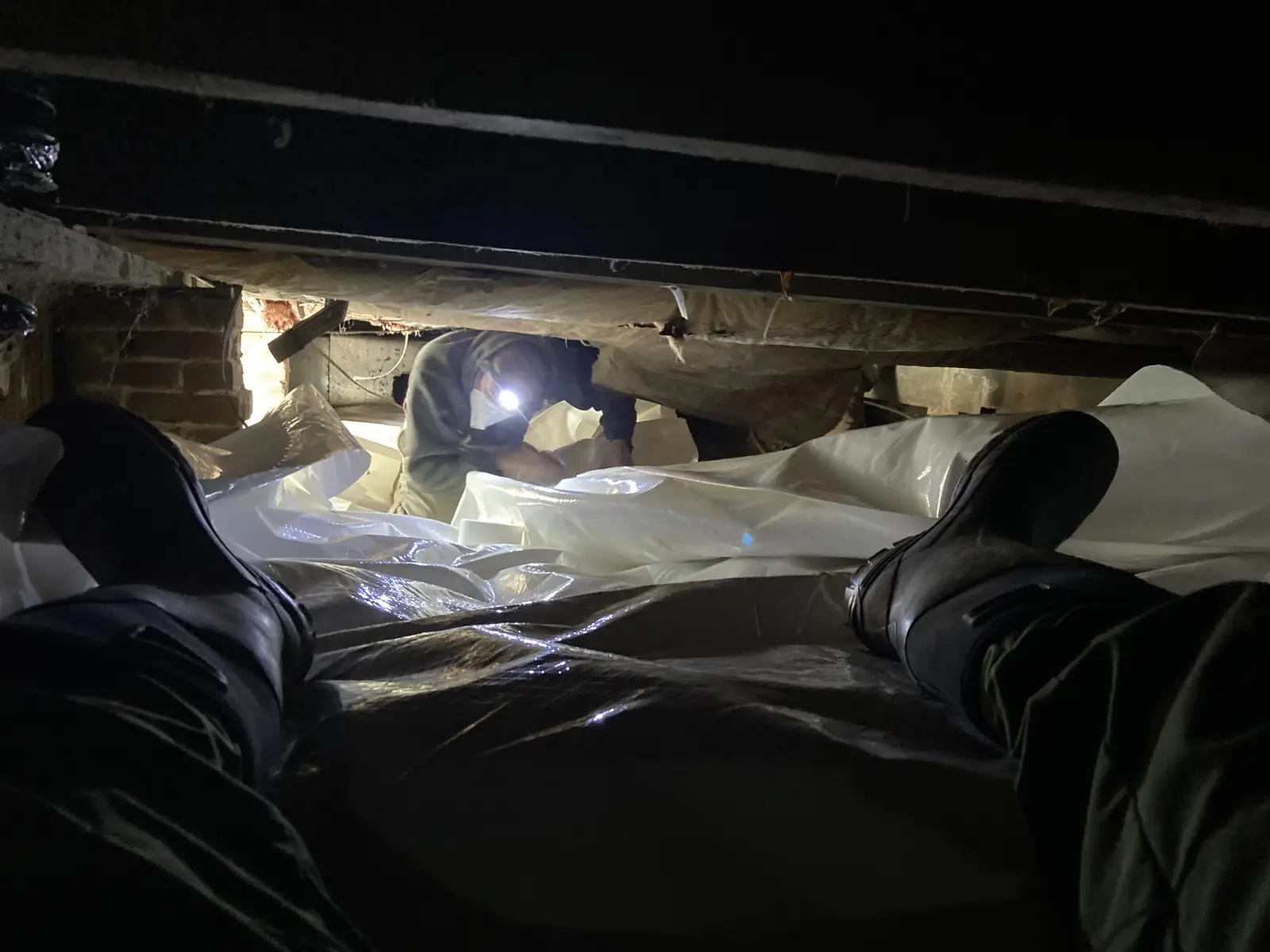
Crawlspace encapsulation means sealing your crawlspace off from the ground and the outside air with a heavy vapor barrier, then controlling the humidity that is left. Done right, it stops the dirt smell, the wood rot, the pests and a real share of the stale air that ends up in your living room.
A crawlspace is the one part of the house nobody actually walks through. You look at your roof, you look at your gutters, you look at your basement if you have one. The crawlspace stays dark and out of mind until something upstairs starts smelling like dirt, or a floor starts feeling soft near an exterior wall. By then the space under your house has usually been damp for years.
That matters more than most homeowners realize because of the stack effect. Warm air rises through a house and leaks out at the top, which pulls replacement air in from the bottom. In a house with a vented, unsealed crawlspace, a large share of the air you breathe on the second floor started as air sitting over bare dirt under your first floor. If that dirt is damp, that air is carrying moisture and whatever is growing in it straight up through your subfloor.
So the fix is not just laying plastic on the ground. It is turning the crawlspace into a sealed, conditioned space instead of a vented, uncontrolled one.
Signs you need this
What the first crawl actually finds
- Standing water or wet mud between the piers, especially near the low corner of the foundation.
- Insulation sagging out of the floor joists, wet, or missing altogether where it fell.
- Exposed dirt with no ground cover, or an old barrier torn up and pushed to one side.
- Piers or beams with soft, dark or spongy spots where a screwdriver sinks in easily.
- Ductwork sitting in mud or resting directly on the ground.
- Foundation vents that are open and unscreened, letting humid summer air straight in.
- Signs of pests, mice, insects, or old droppings along the sill.
- A musty or earthy smell in rooms directly above the crawlspace.
How we do it
What we do under your house, step by step
-
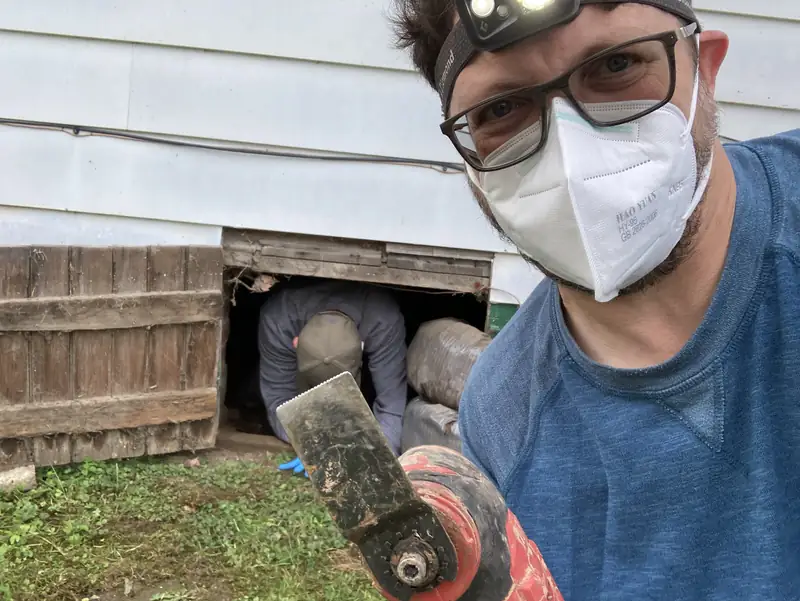
Crawl the whole space first
We check standing water, insulation condition, wood moisture at the piers and beams, exposed dirt, ductwork, vent placement and any sign of pests before we quote anything. What we find under your house sets the scope, not a standard package.
-
Handle standing water before covering anything
If water is actively pooling, we run it to daylight or to a dedicated crawlspace sump before the barrier ever goes down. Covering active water with plastic just traps it under a liner where you cannot see it.
-
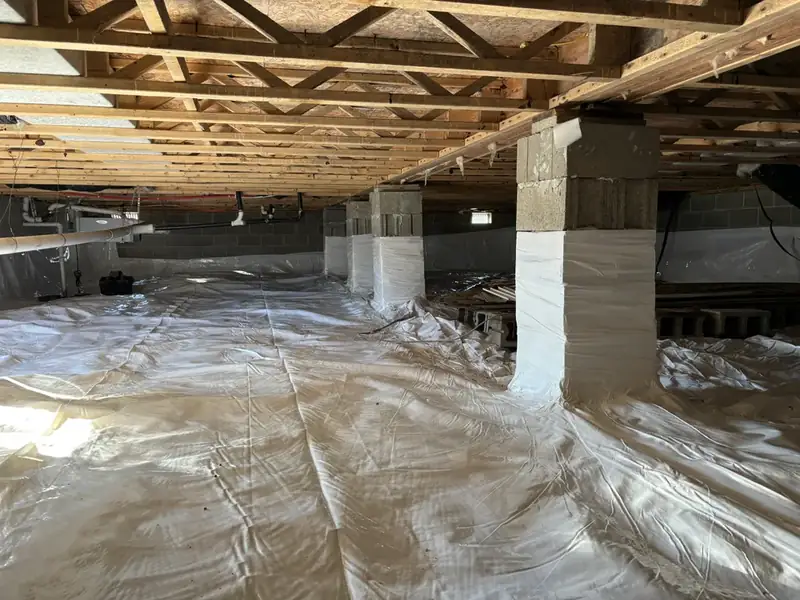
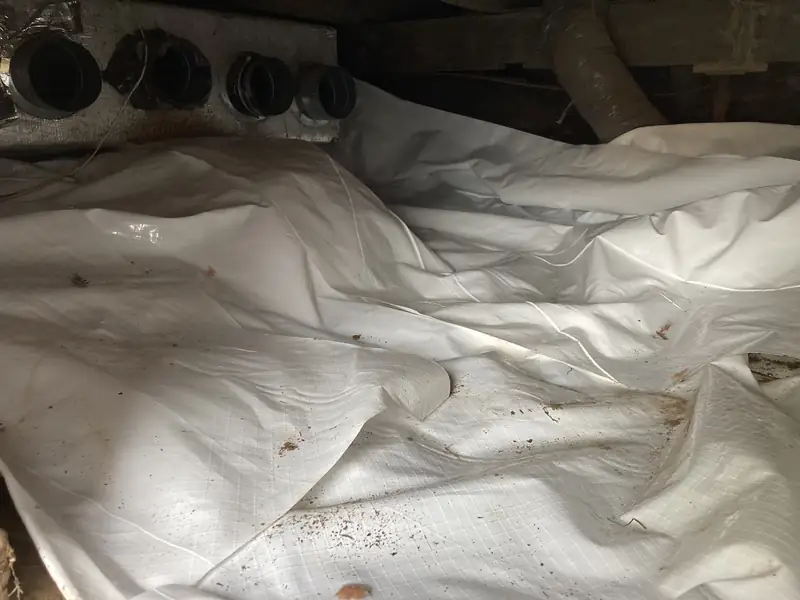
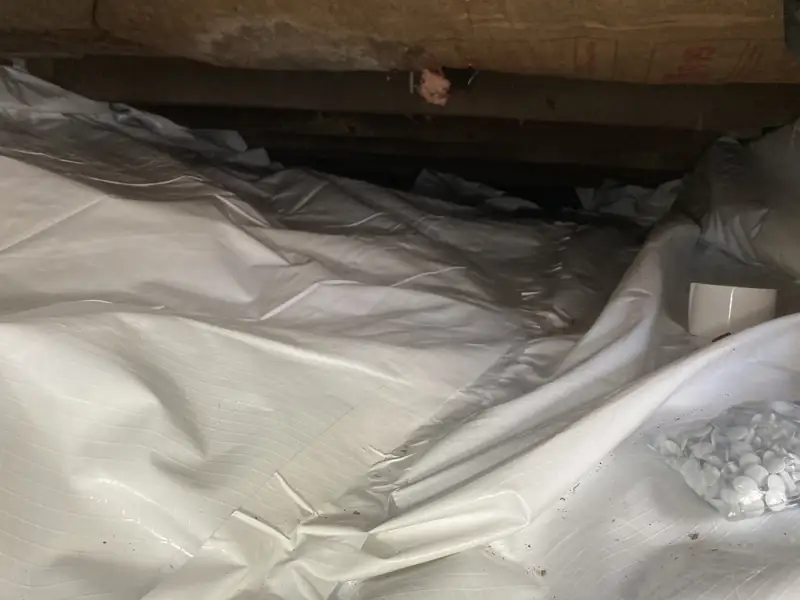
Lay the ground barrier
Flexi-Seal reinforced flexible membrane goes down across the entire floor of the crawlspace, heavy enough to walk and store on without tearing the first month.
-
Lap and seal every seam
Sheets overlap at least a foot, taped seam to seam, then run up every pier and up the foundation wall face and sealed there too. A barrier with an open seam or a gap at the wall is a barrier with a leak in it.
-
Treat the vents
Once the crawlspace is sealed and conditioned, open foundation vents work against you. We close or cover them so outside humidity stops feeding the space you just dried out.
-
Add a dehumidifier where the space needs one
A sealed crawlspace with no ventilation and no active humidity control can still sit at a humidity level that supports mold. A dedicated crawlspace dehumidifier draining to the sump keeps the air in a range wood and ductwork can live in.
-
Set a sump if the crawlspace needs its own
Some crawlspaces take on groundwater on their own, separate from the basement. Those get a dedicated pit and pump inside the crawlspace itself, not routed through the rest of the house.
Materials
What actually goes in
| Component | What we use | Why |
|---|---|---|
| Ground barrier | Flexi-Seal reinforced flexible membrane, full floor coverage | Heavy enough to walk and store on, rather than thin poly that tears the first time somebody crawls across it. |
| Seam tape | Manufacturer-matched seam tape at every overlap | An untaped overlap is just two loose sheets. Vapor and pests both find that gap fast. |
| Wall and pier terminations | Barrier run up every pier face and up the foundation wall, mechanically fastened and sealed | Ground coverage alone still leaves the wall face and pier bases exposed to moisture. |
| Fasteners | Masonry fasteners with sealed termination bar at wall tie-ins | Keeps the barrier from pulling loose at the wall line over years of foot traffic and settling. |
| Drainage matting | Dimpled drainage mat under the barrier in low spots | Gives groundwater a path to the sump instead of pooling under the liner where you cannot see it. |
| Sump | Dedicated pit and liner sized to the crawlspace, where groundwater is present | Not every crawlspace needs one. Where the ground genuinely wets, it earns its keep fast. |
| Dehumidifier | Crawlspace-rated unit with condensate line run to the sump or daylight | Controls the humidity a sealed space would otherwise trap, keeping wood and ductwork dry. |
| Vent treatment | Sealed or mechanically covered foundation vents | An open vent feeds outside humidity straight into a space you just spent money drying out. |
Recent work
Crawlspaces we have sealed up
What it costs
What moves the number
A small, dry crawlspace with a clean barrier and no water issue sits at the low end. A large crawlspace with standing water, a dedicated sump and a dehumidifier added costs a good deal more.
The things that actually move the price:
- Square footage. More floor area is more barrier, more tape, more labor time on your back and knees.
- Access. An 18 inch crawl height takes longer than a walk-in space, and a single small access opening slows material handling.
- Standing water. Getting existing water out and correcting where it comes from is separate work from encapsulation itself.
- Number of piers and obstructions. Every pier and duct run is a termination point the barrier has to be cut and sealed around.
- Whether you need a sump, a dehumidifier, or both. Not every space needs either. Some need both.
- Condition of what is down there now. Removing old torn plastic or damaged insulation is added scope before the new barrier goes in.
You get one fixed number for a defined scope after the on-site crawl. Half holds the date, the balance is due when you have seen the finished space. We do not offer financing.
Often quoted alongside this
What homeowners say
Crawlspace questions
Answers before you call
In central Indiana, usually yes. A vented crawlspace lets humid outside air into a cool, shaded space under your house, and that air condenses on cool surfaces, wood and ductwork included. Older building codes required vents to dry the space out. Encapsulation does the opposite job better, sealing the space off and controlling humidity directly instead of hoping outside air happens to be dry.
It depends on what your crawlspace actually does with water. If the space stays dry underfoot but the air runs humid, a dehumidifier is usually enough. If groundwater shows up on the ground itself after rain, that water needs a pump, and a dehumidifier alone will not fix it. We tell you which one your crawlspace needs after the first crawl, not before.
We use Flexi-Seal reinforced flexible membrane, which is built heavier than the thin poly sheeting sold at a box store. It is rated to be walked and stored on without tearing, which matters because a crawlspace barrier gets crawled across for as long as the house stands.
Warm air rises and leaks out at the top of your house, and that pulls replacement air in at the bottom. In a house with an open crawlspace, a large share of the air on your upper floors started as air drawn up from the crawlspace. If that air carried moisture, dust or a musty smell with it, sealing the crawlspace cuts that off at the source.
It stops the moisture that causes the rot, but it does not repair wood that is already damaged. If a joist or subfloor section has already gone soft, that section needs to be sistered or replaced separately. We flag any structural wood damage we find on the first crawl so you know what is encapsulation and what is repair.
A properly sealed and terminated barrier is not something you need to think about year to year. What does need occasional attention is anything that punctures it, a new duct run, a plumbing repair, or pest activity, so an occasional look through the access point is worth the five minutes.
Where to next?
Free estimate
Let us tell you what is actually under your house.
Send the form and we will reply within about 30 minutes during business hours. The crawl and the written quote are free.
- Full crawl before any quote is written
- Fixed written price for a defined scope
- Flexi-Seal reinforced membrane, sealed and terminated
- Serving all of Indiana from Kokomo and Bloomington