
Drainage contractor in Bloomington, IN
Bloomington is the one city on our whole map that is not sitting on flat clay till. It sits on karst limestone, with bedrock as shallow as 8 feet in places. That single fact changes how water moves under a Bloomington yard.
Local conditions
What is under your yard in Bloomington
- A CITY SPLIT BY A GEOLOGIC LINE Bloomington sits at the boundary of the Norman Upland and Mitchell Plain. West and southwest Monroe County has significant karst development: sinks, ravines, fissures, sinking streams, springs and caves cut into Blue River and Sanders Group limestone. Indiana DNR, Monroe County bedrock geology
- BEDROCK AS SHALLOW AS 8 FEET In the limestone portions of the county, depth to bedrock is often only 8 to 30 feet. Joints, fractures and solution features move water underground fast, rather than filtering it slowly through soil the way clay does. Indiana DNR, Monroe County bedrock geology
- THE UDO HAS A SECTION JUST FOR KARST Bloomington's Unified Development Ordinance has a dedicated Karst Geology subsection, 20.04.040, under Environmental Standards, alongside Steep Slopes, Riparian Buffers, Wetlands and Lake Watershed Areas. City of Bloomington Planning, Unified Development Ordinance
- 46 TO 50 INCHES OF RAIN A YEAR South-central Indiana gets more rain than the rest of the state we serve, roughly 46 to 50 inches annually, with May the wettest month at about 5.4 inches, followed by April and June. Bloomington climate data
- A LAKE INSIDE THE CITY LIMITS Griffy Lake, 109 acres on Griffy Creek, sits inside Bloomington's city limits. Lake Monroe, well south of downtown, is the city's actual drinking water source. Griffy Lake
- A HOUSING MARKET BUILT AROUND 45,000 STUDENTS Bloomington had 36,454 housing units as of the 2020 Census with an 8.9 percent vacancy rate, shaped heavily by Indiana University's 45,000-plus student population and the rental housing that surrounds campus. Bloomington, Indiana overview
Bloomington, specifically
The one city on this site where the ground itself is different
Every other town we work sits on a flat glacial till plain. Bloomington does not, not entirely. The city sits right where the Norman Upland meets the Mitchell Plain, two physiographic regions that split Monroe County. West and southwest of downtown, the ground turns to karst limestone: Blue River and Sanders Group rock cut through with sinks, ravines, fissures, sinking streams, springs and caves. East of downtown the rock shifts again, to Borden Group siltstone and shale. Two different foundations under one city, and neither behaves like the clay we deal with everywhere else.
On the limestone side of town, bedrock can sit only 8 to 30 feet down. That is close enough that a yard is often standing on rock with almost no soil buffer between the surface and a network of joints, fractures and solution features that move water fast instead of slow. On till-plain clay, water percolates down at a crawl, which is why it backs up and pools where you can see it. On karst, water can drop through a crack and vanish, then resurface somewhere else entirely, in a spring or a sinking stream well away from where it went in. A dry well or a soakaway pit that would behave predictably in Kokomo or Carmel can do something unpredictable here. And when we dig, we sometimes hit solid rock exactly where a plan assumed we would not.
Add the hills. Bloomington sits right at the seam between those two regions, and the result is genuinely hilly ground compared with the near-flat till plain that covers most of the state. Hillside runoff concentrates fast toward the creeks that cut through town, and a steep or walkout lot changes the whole picture. Water that would spread out and soak in on a flat yard instead gathers speed coming downhill, arriving at a foundation with more force and less warning than most homeowners expect.
The city takes karst seriously enough to regulate it by name. Bloomington's Unified Development Ordinance carries a dedicated Karst Geology subsection, Section 20.04.040, sitting under Environmental Standards right alongside Steep Slopes, Riparian Buffers, Wetlands and Lake Watershed Areas. A known karst feature near a property can trigger its own review requirements, a set of rules nobody working on the till plain ever has to think about. Layer on roughly 46 to 50 inches of rain a year, more than central Indiana gets, with May typically the wettest month at about 5.4 inches, and you have a lot of water moving through ground built to swallow it in ways nobody can fully predict from the surface.
Two water bodies frame the picture. Griffy Lake, 109 acres on Griffy Creek, sits inside the city limits and now serves mostly as an emergency backup supply. Lake Monroe, farther south, is Bloomington's actual drinking water source. Both are reminders that this city's water infrastructure was built around a landscape that already had its own plumbing carved into the rock long before anyone laid a pipe.
The housing stock adds its own wrinkle. As of the 2020 Census, Bloomington had 36,454 housing units with an 8.9 percent vacancy rate, a figure shaped heavily by Indiana University's 45,000-plus students. A lot of the older housing close to campus is rental stock built on crawlspaces, decades before karst ever showed up on a permit application. Older crawlspace construction combined with unpredictable subsurface water movement is a specific problem we see near campus that never comes up on a flat clay lot in Kokomo.
The city also charges a flat $7.50-a-month stormwater fee on single-family homes and runs the whole program under its own ordinance, Title 13, most recently revised by Ordinance 2025-24 on 30 July 2025. We have a base right here in Bloomington, so this is ground we know well. We check what a lot's actual geology and the city's rules allow before we ever put a shovel in it.
Parts of Bloomington we work in
Bloomington neighborhoods and landmarks we know well. This is coverage information, not a list of links.
Elm Heights Bryan Park Prospect Hill Near West Side Park Ridge Broadview Hyde Park Village Peppergrass Sherwood Oaks McDoel Gardens Highland Village Old Northeast Downtown near Indiana University near Griffy Lake toward Lake Monroe along the B-Line Trail near Switchyard Park
What we install here
Services in Bloomington
- Yard Drainage Designed around karst, not assumed clay
- French Drain Inside the basement, cut in along the wall
- Downspout Drainage Kept clear of known sinks and fissures
- Downspout Extension A fast first move on a steep lot
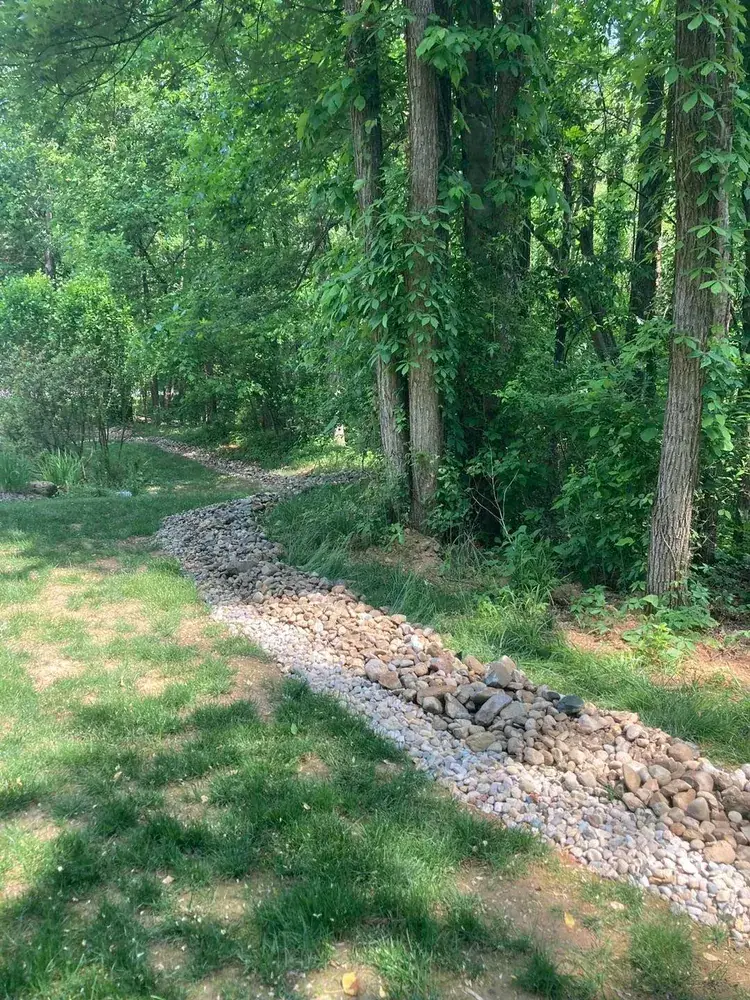
- Trench Drain Hand-dug, rock-covered drains through the yard
- Foundation Swale A rock-covered trench along the house
- Wet Yard Solutions When water resurfaces where you don't expect it
- Wet Basement Solutions Block walls sitting close to bedrock
- Crawlspace Solutions Common in older near-campus rentals
- Sump Pump Installation With battery backup for storm season
- Stone Walkway Creation Finish work built for hilly terrain
Karst rules and the MS4 ordinance in Bloomington
Bloomington's Unified Development Ordinance treats karst geology as its own regulated environmental feature, in a dedicated subsection, 20.04.040, alongside Steep Slopes, Riparian Buffers, Wetlands and Lake Watershed Areas. On a property near a sink, a sinking stream or another known karst feature, that can affect what kind of grading or drainage work the city will allow.
Separately, the city runs a regulated MS4 stormwater program under its own ordinance, Title 13, most recently revised by Ordinance 2025-24 on 30 July 2025, backed by a flat $7.50-a-month residential stormwater fee. Development disturbing an acre or more has its own runoff standards to meet.
We check what applies to your specific lot, karst feature or otherwise, during the free estimate and tell you before we dig, not after. City of Bloomington Utilities, Stormwater Management Ordinance.
Nearby towns we work in
- Ellettsville
- Spencer
- Nashville
- Martinsville
- Bedford
Reviews from around Indiana
These come straight from our Google Business Profile, including the reviewer's own town.
Bloomington questions
What Monroe County homeowners ask
On karst ground, that is normal in a way it never would be on clay. Joints, fractures and solution features in the limestone under western and southwestern Monroe County move water fast once it finds a crack, sometimes straight down into the rock rather than across the surface. It did not really disappear. It found a path underground that a clay yard simply does not have.
That is also why a soakaway or dry well that works fine on till-plain clay can behave unpredictably here. We test how a specific lot actually drains before we design anything.
Karst development is concentrated in western and southwestern Monroe County, in the limestone of the Blue River and Sanders Groups, while the east side of Bloomington sits more on Borden Group siltstone and shale. Neither side is uniform, and bedrock depth can vary block to block. We check what we are actually digging into during the free estimate rather than assuming based on which side of town you are on.
Yes, and it is one of the more common calls near campus. A lot of the rental housing around Indiana University, which enrolls more than 45,000 students, was built decades before anyone was thinking about karst on a permit application. Older crawlspace construction sitting on shallow bedrock is a specific combination we see close to campus that a Kokomo till-plain crawlspace never presents.
It does. Bloomington sits right where the Norman Upland meets the Mitchell Plain, which makes the ground here genuinely hilly compared with the near-flat till plain covering most of the state. On a steep or walkout lot, hillside runoff gathers speed as it comes downhill instead of spreading out and soaking in, so a line has to be sized and pitched for that added volume and force, not just for the water landing directly on your own roof.
Sometimes, depending on what is actually on your property. Bloomington's Unified Development Ordinance has a dedicated Karst Geology subsection, 20.04.040, and a known feature nearby can trigger its own review requirements. We are honest about this upfront: we check what applies to your specific address before we plan a route, and we tell you if something needs a city look before we dig.
Where to next?
Free estimate in Bloomington
Karst makes the ground unpredictable. We do not guess at where the water is going.
Send the form and we will reply within about 30 minutes during business hours, or call and talk to a person now.
- Free on-site visit anywhere in Monroe County
- Grade and geology checked before we design anything
- Dug by hand, so shallow bedrock and karst features are respected, not disturbed
- Fixed written price before anything starts