
Drainage contractor in Kokomo, IN
There is a soil series named after this town. The USDA classifies it as very poorly drained. If your Kokomo yard holds water, the ground under it is a big part of the reason.
Local conditions
What is under your yard in Kokomo
- THE SOIL IS NAMED AFTER YOU The Kokomo soil series has its official type location in Howard County. The USDA classifies it very poorly drained, forming in depressions on the till plain, with a seasonal high water table that ranges from one foot above the ground surface to six inches below it. USDA NRCS Official Series Description
- EVEN THE GOOD SOIL IS CLAY Miami, the better-drained upland series on the higher ground around here and Indiana's state soil, is only rated moderately well drained. It carries 27 to 35 percent clay in its subsoil and holds a perched water table two to three feet down from December through April. USDA NRCS Official Series Description
- 44 INCHES OF RAIN A YEAR Kokomo averages roughly 44.4 inches of precipitation annually plus about 34 inches of snow, on a humid continental pattern with a real freeze and thaw cycle every winter. Kokomo climate summary
- FLAT GROUND, ONE CREEK The city sits around 820 feet on a glacial till plain, with Wildcat Creek running along the north side. The creek drains about 804 square miles, and in the 1913 flood it overtopped its levee and spread nearly a mile wide after 6.59 inches of rain. Wildcat Creek
- ROOF AND FOUNDATION WATER IS ALLOWED IN THE STORM SYSTEM Kokomo runs an MS4 stormwater program under an IDEM permit, and the city's illicit discharge rule specifically lists roof downspouts and foundation drains as permitted, non-prohibited discharges to the storm system. City of Kokomo Stormwater
- PARTS OF TOWN ARE ON COMBINED SEWERS Kokomo operates a combined sewer system in parts of the city under a state-mandated overflow control plan for Wildcat Creek and Kokomo Creek. Its peak wet-weather treatment capacity was raised from 80 to 130 million gallons a day. Indiana Finance Authority, Kokomo wastewater
Kokomo, specifically
Why so many Kokomo yards behave the same way
Most drainage problems come down to two questions. Where does the water land, and where can it go? In Kokomo, the second question is the hard one.
This part of Indiana is a glacial till plain. The glacier flattened it and left behind a dense, clay-rich subsoil, and then the local landscape settled into a pattern of very slight rises and very shallow depressions. Those depressions are where the Kokomo and Brookston soils formed, and both are rated poorly to very poorly drained. On a Brookston or Kokomo soil, the seasonal high water table can sit at, or even above, the ground surface. That is not a figure of speech from a marketing page. It is how the USDA describes the dirt in your back yard.
So when a homeowner off South Park Road tells us the low corner of the lawn has been soft since March, nothing unusual has happened. The water table came up, the clay under it will not let anything percolate down, and the depression that made that soil in the first place is doing exactly what it has done for ten thousand years. The difference is that there is now a house on it.
Add the rain. Kokomo takes about 44 inches a year, with June typically the wettest month, and roughly 34 inches of snow that melts into saturated spring ground. Then add the freeze and thaw cycle, which works soil loose around foundations and helps backfill settle. Twenty years after a house goes up, the ground that was graded away from the wall on day one has often gone flat, and sometimes gone the wrong way.
The housing stock matters too. Kokomo has about 29,500 housing units and a median home value of $137,400, which tells you plainly that this is not a market full of brand-new construction. It is a Rust Belt city that grew up around the Stellantis transmission and engine plants and the auto supply trade, with a lot of mid-century homes on block foundations and crawlspaces. Block is porous, mortar joints are more porous, and a wall standing in saturated clay for six weeks each spring will eventually let water through.
None of this means a Kokomo lot cannot be drained. It means the design has to respect very little fall. On a lot with two feet of drop across 150 feet, you do not get to be sloppy about pipe pitch or outlet elevation. You shoot the grade properly, you set the line to the fall you actually have, and you find a real outlet, whether that is a street-side storm inlet, a ditch, a swale between properties, or a daylight point on a low corner. The city's stormwater rules explicitly allow roof downspouts and foundation drains to discharge into the storm system, which gives us a legitimate destination on plenty of in-town lots.
What we do not do is bring a mini excavator into a Kokomo back yard to solve it. On this soil, machine tracks compact wet clay in a way that takes years to recover, and compacted clay is the original problem. We hinge the sod back with our zipper method, dig by hand, set the pipe and stone, and fold the turf into the exact spot it came from.
Parts of town we work in
Kokomo neighborhoods and landmarks we know well. This is coverage information, not a list of links.
Downtown Kokomo Indian Heights Forest Park Highland Springs Maple Crest Fairlawn near Highland Park near Jackson Morrow Park along the Walk of Excellence Industrial Heritage Trail area near IU Kokomo Foster Park area Kokomo Country Club area South Park Road corridor
What we install here
Services in Kokomo
- Yard Drainage For flat till-plain lots
- French Drain Inside the basement, cut in along the wall
- Downspout Drainage Allowed into Kokomo storm system
- Downspout Extension The cheapest first move
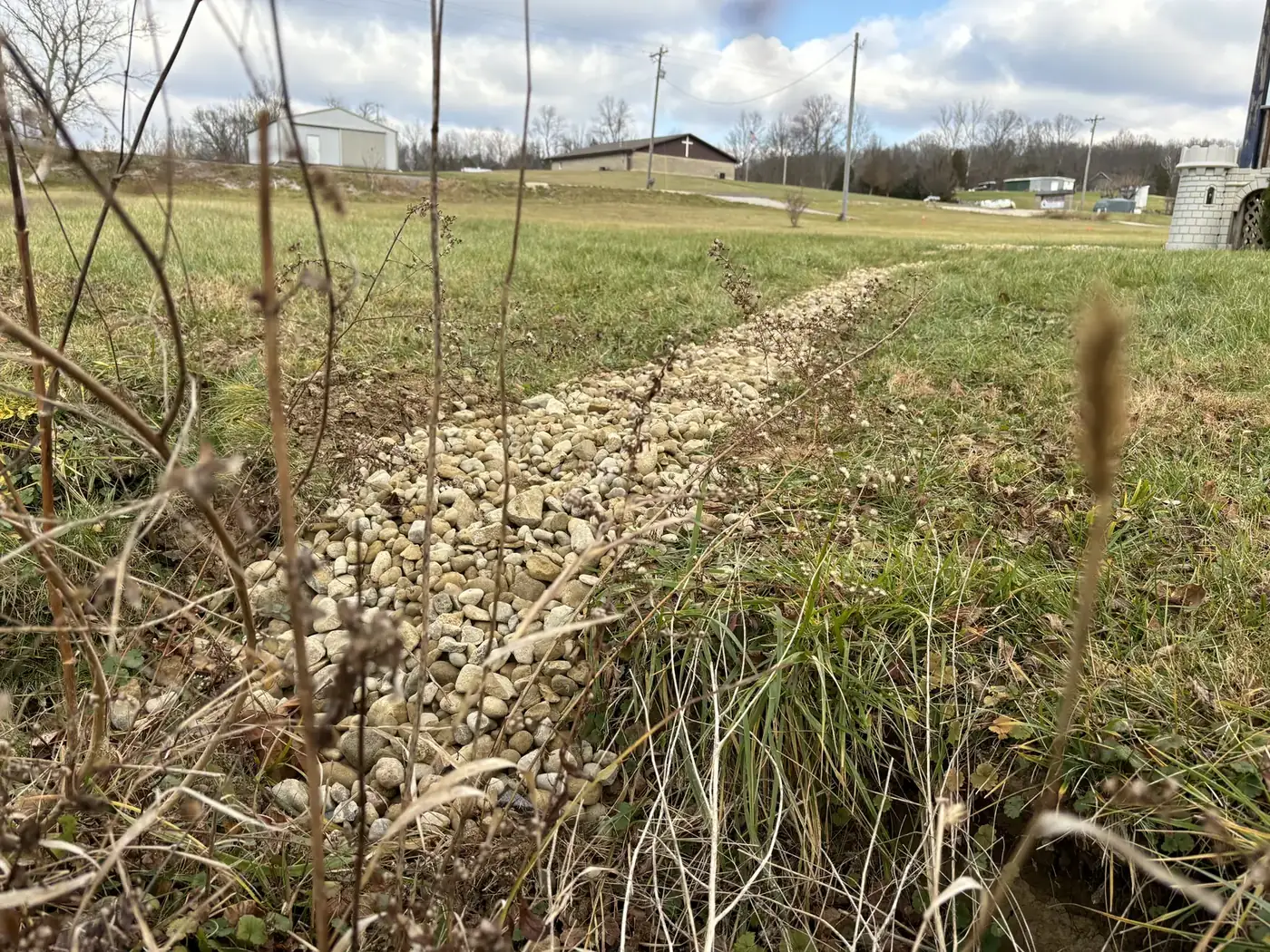
- Trench Drain Hand-dug, rock-covered drains through the yard
- Foundation Swale A rock-covered trench along the house
- Wet Yard Solutions When clay is the culprit
- Wet Basement Solutions Block walls in spring water table
- Crawlspace Solutions Common on mid-century homes
- Sump Pump Installation With battery backup
- Stone Walkway Creation Finish work on the same visit
Before you discharge anything in Kokomo
The City of Kokomo runs a regulated MS4 stormwater program under an IDEM permit and issues stormwater construction permits scaled to the size of the project, through its Operation MS4 system. For ordinary residential drainage that stays on your own lot, that generally does not apply. It starts to matter when a line crosses into the right-of-way or ties into a public storm structure.
The useful part for homeowners: the city's illicit discharge rule lists roof downspouts and foundation drains as allowed discharges to the storm system, which gives a lot of in-town lots a legitimate outlet. Parts of Kokomo are also on a combined sewer under a state-mandated overflow control plan, so a discharge that ends up in the sanitary side is exactly what the city is spending money to prevent.
We check what applies to your address during the free estimate and tell you before we dig, not after. City of Kokomo Stormwater page.
Nearby towns we work in
- Greentown
- Russiaville
- Sharpsville
- Galveston
- Windfall
- Tipton
- Peru
Reviews from around Indiana
These come straight from our Google Business Profile, including the reviewer's own town.
Kokomo questions
What Howard County homeowners ask
Almost always, yes. Flat is a design constraint, not a dead end. What matters is total fall from the wet area to a usable outlet, and on most Kokomo lots there is more of it than people think once you actually shoot it with a level. Where there genuinely is not enough fall to reach daylight, the answer becomes a collection point and a pump rather than gravity alone.
The visit is free, so the honest answer to this question costs you nothing to get.
Depending on your address, one of four places: a low point on your own property where it can daylight, a swale between lots, a roadside ditch, or a city storm structure. Kokomo's stormwater rule lists roof downspouts and foundation drains as allowed discharges to the storm system, which makes that last option real for a lot of in-town lots rather than a gray area.
What it must not do is end up in the sanitary side. Parts of Kokomo run combined sewers, and the city is under a state-mandated plan to reduce those overflows into Wildcat Creek and Kokomo Creek.
Because a summer storm is a surface event and spring is a water table event. On Kokomo and Brookston soils the seasonal high water table sits near or above the ground surface in late winter and spring. A crawlspace floor a foot below grade is then sitting in wet ground for weeks, not hours, and the moisture evaporates upward into the space no matter how well the storm drained off the surface.
That is why we seal the ground with a heavy vapor barrier instead of only chasing the surface water.
Yes. Greentown, Russiaville, Sharpsville, Galveston, Windfall, Tipton and Peru are all towns we work in regularly, and rural Howard County lots are some of our most common work. Out there the outlet is usually a field tile, a roadside ditch or an existing swale rather than a city storm inlet.
In August, honestly, yes. Dry Howard County clay is hard work. That is priced into the quote, and it is still worth it, because the alternative is running a tracked machine over saturated or newly compacted clay and creating a soil problem on top of the water problem. Spring and fall ground digs far easier, which is one reason our schedule fills up in those seasons.
Where to next?
Free estimate in Kokomo
We are based here in Kokomo.
Send the form and we will reply within about 30 minutes during business hours, or call and talk to a person now.
- Free on-site visit anywhere in Howard County
- Grade shot with a level, not guessed at
- Dug by hand, so the clay does not get compacted
- Fixed written price before anything starts